Monday, February 24, 2014


WHY I WRITE AS A READER
          Lately, as a reader, when I go through modern novels, I find many parts to skip; long descriptive passages or background data-dump kicks away my interest.
Maybe that’s why I tend to stick with noir crime stuff.
When I’ve been seduced by a hot cover and I like the blurb on the back enough to buy the book, I demand one thing from the writer: Tell me a story and start on page one. Meaning, get your guy/gal up that tree, throw enough rocks to make him/her stumble and fall through the branches, give him/her a come-to-realize, life-changing car-crash event then get him/her down out of the tree. Don’t dawdle with philosophical meanderings or moralizing or messages—even though John D. MacDonald was taken to task for his observations about the world around him. Critics noted, because of those his work was not pure genre, never mind how endearing his writing was to the reader. I’m also guilty of committing acts of observation in my novels, endearing or not.
We shouldn’t squeeze in a lot of detail, especially about characters—characters reveal themselves through action, quirks, dialog and gestures—and have been doing so from Shakespeare to Dickens to Mark Twain to Ernest Hemingway to Elmore Leonard, who advised us to leave out character descriptions, maybe a short sentence or two. Another lesson I should work on. I still do too much, though I’m working the problem—not the challenge—the problem. It’s a popular disease among today’s writers.
As a tarnished old sea dog with decades pounding keys through this writing racket, I’ve learned when you write as a reader, the #1 reader had better be you. Don’t cater or prostitute yourself for any group, trend or what’s popular. Write for the personal you.
Fact One: No matter who you are or where you are or what you write, somebody, someplace for some reason is going to be offended. It is human nature and cannot be helped. 
Fact Two: Those closest to you will be the most critical of your work. Knowing you makes them feel they have the right.
I’ve been doing some reading lately. I’ve read or reread several Elmore Leonard novels (‘Pronto,’ ‘Riding the Rap,’ ‘Killshot,’ ‘Pagan Babies,’) plus Lawrence Block’s ‘Hit Man’ a collection of short stories about hired killer, Keller; ‘Black Cherry Blues’ and ‘Jolie Blon’s Bounce’ by James Lee Burke, about Dave Robicheaux (brilliantly portrayed by Tommy Lee Jones on the screen). And back to my favorite, Richard Stark and his Parker series—all these were bought at the dollar used book store for a buck each. I donated them back when I was done. I have the latest Jack Reacher and I’ll be getting to it eventually. Currently I’m reading ‘Dirty Money,’ a Parker novel on my Kindle.
 
          In writing, I’m working on my first Mac Tuff novel, ‘Pillow Shot,’ about kick-ass gal private eye, Makayla Tuff—beautiful, built, brainy, and tough as her last name. That’s my morning stuff. Afternoon’s I rework my pre-digital (before anyone heard the word, eBook) novels to prepare them for new release, rewritten with new covers under my Seaweed Library logo. I’m going independent through KDP Select these days. My rewritten books with new covers aren’t available yet. The originals are out-of-print and book sellers gouging readers with ridiculous high prices. Do not buy them. The new books with reasonable prices will be coming during the next few months. Keep checking Amazon if you’re interested. Not included in the “do not buy,” my three latest: ‘Satin Shorts,’ ‘Crossfire Diamonds,’ ‘The Farewell Heist.’ Good stuff for those who like crime novels.


          What I like as a reader and strive for in my writing is the story, the story, the story, and an interesting main character. I have two characters besides Mac Tuff: Logan Sand, a raw, hard PI, ex-boxer, who left Navy Intelligence when political infighting and government corruption got to him, and who while working his cases leans more on the criminal side of the fence. Two Logan Sand novels are done: ‘The Calcutta Dragon’ and ‘Plundered Angels,’ due out shortly. Finally there’s Bay Rumble, a sailor who just wants to see the world aboard his small sailing vessel and keeps running into killings, treachery and very bad women as he sails from port to port. Three pre-digital books are being reworked in that series: ‘Bad Girl Dead,’ ‘Bleeding Sisters’ and ‘Catalina Killers.’ The fourth, ‘Baja Bullets’ is available through Amazon, and the publisher (til July) Solstice Publishing.


          In reading I like clear simple words, not sentences cluttered with so many syllables they send the reader to the dictionary. When the reader has to visit a dictionary, he/she stops reading the book. Other demands might keep the book from being revisited for awhile—or forever. You might lose the reader for good. I write simple words.
          A page reads best with four or more paragraphs, the more the happier quicker reading. Dialog is great because almost every line is a new paragraph. No long-winded cliché-ridden speeches though or you’re back to one or two skip-over paragraphs.
          For readers, some novels and short-stories approach the repetition of television commercials. They are as irritating as the jerky camera in today’s movies (like a junior high kid with an 8mm). Their premise—what they’re about—has already been done to strangulation. They enter the realm of what I label: “Hey, the mule is dead, quit beating on it.” A small sample are books and stories about: OUTLAW MOTORCYCLE GANGS, with or without drug dealing—VAMPIRES and all the blood-sucking crap that goes with them—LITTLE CHILDREN IN JEAPORDY, come on, writers, quit with the abuse, kidnapping, missing, city chasing, close-call shots, heart wrenching, done again and again lazy writing and think original. And I carry personal prejudice against stories about: SERIAL KILLERS, GRIZZLED OLD AGENT-COP-PI WITH YOUNG GUY/WOMAN AGENT-COP-PI, science fiction that THREATEN-DESTROY-DISEASE-END THE GLOBE, COUNTRY, CITY OR NEIGHBORHOOD, weathered old dude PULLED FROM RETIREMENT FOR ONE LAST CASE, RESCUE, SPY JOB, MISSION, the many BADLY-WRITTEN IMITATIONS OF CURRENT POPULAR BOOKS (Fifty Shades of Grey, Harry Potter, etc.). There are many others but you get the drift.
Over the fence, some subjects become favorites with crime readers and can be written often: HEIST—ROBBERY—KNOCK OFF THE SPOUSE/PARTNER—CHEATING THAT LEADS TO KILLING—CROSS COUNTRY CHASE—BLACKMAIL—REVENGE—PERSONAL KILLING JUSTICE—THE HUSTLE (and now, Gert and Clyde we present all those badly written ‘American Hustle’ wannabees)—THE DOUBLE-CROSS— THE CON—THE GRIFT. Love them all.
          I don’t know why sex and violence are always stirred together in the same soup pot. My early novels had too much sex and foul language. My elderly Christian aunts stopped reading them because they thought the writing approached pornography, though they did and do enjoy my non-fiction and memoirs. It isn’t like they disowned me, not like Jack London whose mom considered him a “constant disappointment.” Or Hemingway’s bible-thumping mother who thought his novels were, “violent filth,” My aunts still love me but they won’t read my fiction. Mom is long gone but she never approved of my stuff either.
           My writing these days, instead of lengthy female curve description and blow-by-blow gyration and hot breath coupling, the sex act is summed up in a few sentences that basically read: “They had sex.” Much torrid build-up can preface the act through dialog with heavy breathing created by what is left out. Violence doesn’t need gutter talk or to describe how the slug tore skin open and how the wound filled with blood and how the eyeball twisted and fell out to hang by a few threads of flesh. “I shot him through the eye and the chest,” explains well enough. The reader knows the guy got shot and it had to hurt like hell and there must have been a lot of messy blood.
          Sometimes I write about real places, other times made-up fake. Since I’m a word-god I can put any structure I want on any street corner I choose.
In ‘Plundered Angels,’ I needed a cult-religion hangout in Seattle. Though I used to live in Seattle, I couldn’t come up with one so I borrowed a building I’d seen in San Diego and put it on the curb there in Seattle, complete with lighted lavender sign.
In the Logan Sand series there’s a tavern called Tim’s Bar and Grill in downtown Bellingham. It’s not far from the waterfront and marina. It doesn’t exist. Furnishings for the interior came from a saloon in Oakland where Jack London drank while writing notes for ‘Call of the Wild’ when he got back from Alaska. Years later, I sat in the same chair, took mental notes of the place, and lifted a few beers in memory of the former local oyster bed pirate.
 
In my award winning novel, ‘The Farewell Heist’ the town of River Beach in Northern California is made up. I drew a map with the cannery, river; railroad tracks over the bridge, the dumpy area known as Splinterville, the beach where high school kids made out—it’s all as fake as political integrity.
 
I put made-up places in real towns and invent fake towns. My gal PI, Mac Tuff operates out of Branch Lake, Arizona, population 9,000, located along Highway 95 about eight miles north of Lake Havasu. Branch Lake doesn’t exist. I made it up.
In the Logan Sand novel, ‘The Calcutta Dragon,’ I needed a ski resort by the Nooksack River east of Bellingham so I built Rock Point in my head stealing motels and bars from other places, and placed them along the main drag leading to the lodge (similar to the one at Mt. Baldy, California), along with scattered cabins and deep canyons where bodies could be tossed.
 
          When I moved away from regular publishers and went independent, I gave some thought about what to charge for books. A lot of 99¢ books are offered. When I think 99¢ I think a cheap price for a cheap product. I don’t let myself get wrapped up in the competition thing. Competition is and always will be around. I draw readers of hardboiled crime noir novels, the type of books I read and write. Others wouldn’t be interested in my books at any price. People who read my novels like them (excluding my aunts).  New, they are worth more than 99¢. Used, they can go for whatever can be yanked away. I’m already out of the loop at that point.
 

My book, ‘Three for the Gun’ contains three short stories introducing my three characters, the blurb something like “three characters, three stories, Three for the Gun.” It’ll probably run from 25 to 35 pages. The going price will be $2.99 digital, under $10 print. At times it will be offered free. My thinking is forget 99¢, either offer it free when Amazon allows (and only for a few days) or get full freight for it. The reworked novels will also be $2.99 digital and under $15 print. My new novels will be $3.99 digital, under $15 print. None of my books will be under $2.99 digital or over $3.99 digital. All my books will one-at-a time be offered free for a few days. Sorry, I’m just not a believer in 99¢. My previous publisher tried and sales were pathetic. I don’t believe any digital book is worth more than $3.99, no matter who wrote it or how long it is. To see them at $15 and more defeats the purpose of digital reading, books available at reasonable prices. I won’t pay those prices, not even for Parker.
          Writers are readers, or they should be. Many writers bounce in and out of social sites thinking to find readers. But what you have are writers trying to sell books visiting writers trying to sell books. You end up with a lot of self-promotion. And I include myself in self. I do learn and earn from the sites and will continue to visit them. But they are not the main source of marketing for my books. Since almost nobody in my family uses computers or electronic readers, and only five percent of my writers critique group has eBook readers, I must mostly rely on the kindness of strangers for digital sales. For print, I send flyers to retirement homes, to book clubs and newspapers and magazines and bookstores; I do book signings at small bookstores; did appear on radio, have a table at the Sunday Farmer’s Market with the same poster I use on the deck of my small sloop wherever I anchor: Buy my books—Make me famous—Here—Now. I’ve even sold books from my car like John Grissom did before they made a movie of ‘The Firm’ (he never had to do that again). Plus, I’ve written an unproduced spec-script for each one of my novels (I specialize in unproduced screenplays). Then there are the books I sell in taverns while shooting eight-ball pool tournaments. It all helps.
Books: Order from any bookstore, or: www.amazon.com/georgesnyder/e/b007upcafg


Wednesday, January 8, 2014


WRITING AND BOAT LIVING


          I find as years accumulate, I’m drifting toward minimalist living. Things mean less. The line grows sharper between want and need. It’s the wants that do us in; we actually need little. Toward that end, I long ago made the decision to move off dirt.

          Boats have been a part of my life since the seventies. Even before, in the Navy I served aboard the USS Shangri La, an aircraft carrier that introduced me to the varied pleasures of the Far East. My life of boats includes designing, building, sailing, and life aboard, for any vessel I own must also be my home. While living in Seattle during the mid-seventies to early eighties, writing screw and kill Nick Carter paperbacks, I built a 34’ catamaran that I subsequently sailed from Puget Sound to Juneau, Alaska and return (more like motored, you don’t sail the Inside Passage), looking to salmon fish and gold pan. When vandals destroyed that boat, I moved south again to San Jose, then Long Beach, California, now writing the Operation Hang Ten series of screw and kill spy novels under the name, Patrick Morgan.

          During this time I became a permanent boat dweller. From 1984 onward, I have never returned to live on dirt. The vessel I bought was not only the smallest I’ve owned, a Columbia 26’ but I lived aboard her longer than any other, ten years, while I wrote a couple of memoirs and many sailing articles. I solo sailed that little ship down the Baja coast to Cabo San Lucas and around to La Paz where I lived at anchor for four months, writing screenplays that went nowhere; then I coastal and island hopped for a year through the Sea of Cortez, writing more screenplays that went nowhere. This was affordable because: my boat was small; my boat was simple; I sailed alone. Mornings after hot oats in non-fat milk and honey, I wrote. My diet became rice and fish. I dove for supper every evening, snorkeling with my Hawaiian Sling after pan-size trigger fish, a mild tasting fish so plentiful they seemed to impale themselves on my spear. By snorkeling instead of rod and reel fishing, I had the choice of what to eat. Many large grouper zipped past me down there but they were too big for one meal and I had no refrigeration. Two of the tasty fish sizzling on the small barbecue while rice boiled was enough to whet anyone’s appetite. Small villages carried some fruit and vegetables so I added a tomato, onion, cucumber salad swirling in olive oil and vinegar to the rice and fish. I’ve eaten an apple every morning of my life for decades.

          While in Mexico, I started putting together the first of my continuing crime novel characters, Baylor “Bay” Rumble, a guy who designed and built a 30’ sailing catamaran and while sailing the world runs into murder, alley fights, gun-toting men, treachery and women so slick and hard they can chop trees with their heart. To date I’ve written four in the series. The character of Bay has been followed by Logan Sand, a Northwest Private Eye so tough you can light matches on his skin. There are two in that series. Logan was recently followed by the tough woman PI, Makayla “Mac” Tuff, who operates out of a little town north of Lake Havasu, Arizona where she works and lives in a 22’ Airstream. I’m currently writing the first in her series.

Ah, but sailing north, I smashed my little sloop on the wicked shore south of San Felipe in twenty-three foot tides.   

          Four times in my life I have been stripped of all I own and had to start over with nothing, not even a home. Each time the loss bites deeper with more stuff accumulated, but recovery is easier because the value of things diminishes. All those precious possessions turned out to be not so precious. Think about it. You wake up and everything you own, including your home, is gone. No insurance. You must begin again from scratch. How tough would that be for you?

While working as a bartender to save for my next boat, I rented an old sloop from my Australian buddy who had moved back on dirt with his girlfriend. My small Columbia was replaced, and those replaced until I bought my present boat, a Cal 29’ that has been my home for seven years.

What’s it like writing and living on a small boat?

          I’ve always owned small boats because they are simpler and cheaper to keep up. Electronic-laden big yachts are for the rich and I’ve never been rich. I prefer sail rather than power boats, I enjoy covering distance by free wind, like I’m getting something for nothing, a bicycle whizzing downhill, a free ride. Although cabin cruisers certainly offer more living space per foot, they also offer more systems and gadgets to self-destruct. The sea environment quickly eats up electronics and electricity, which don’t live a happy life there. Ask any skipper and he/she will tell you that every piece of electronics aboard has failed at least once. Yes, sail boats can be complicated. My Cal 29 was set up for racing; we dock rats did race her in the Newport Beach to Ensenada, Mexico race and did well, eighth in class. I’ve tried to simplify the rigging as I did the little sloop I sailed to Mexico. These days I have as much interest in sailboat racing as I do in lawn mowing. Certainly a 30’ cabin cruiser will offer more living space but there’s nothing I can do about that, I like to sail.

The layout of most sail boats has the anchor at the bow in its own locker. Moving back there is the V-berth, which can be a double (mine is queen), then the head or toilet with hanging closet opposite. I don’t like that arrangement with the toilet next to the pillow where I sleep, even with a thin plywood door between, but almost all small boats are designed that way. Next is the main cabin which is usually a dinette of some kind. The galley may be aft near the entrance hatch or it may take up one side along a narrow aisle across from the dinette. My Cal 29 has this set-up. I don’t care for it. My little Columbia Sloop had a long seat on one side, a dinette on the other and the small sink/propane stove next to the entrance hatch. I consider the only place for a stove is under the main hatch. Otherwise cooking splatters and the result coats everything in the cabin. Some boats have seats along both sides with a folding table in the middle. My next boat will be something like that. It is considered the “traditional” layout. Most boats have a large outside cockpit aft with two seats about six feet long. An awning makes it comfortable and much writing can be done on a folding table during nice weather at anchor. An inverter gives you power from a twelve-volt system. Solar panels can provide charge but there is a Honda generator in my future. The smaller the boat the less of this you get, though in our marina there is a Columbia 22’ with a satellite dish. Down around 22’-23’, the toilet might not have its own compartment but slide out from under the V-berth. I’d rather have it along the settee or seat in the main cabin. That size boat is not going to attract much of a crowd so privacy is not an issue. A small boat means smaller costs for everything to maintain and use her.

Until you reach 27’-28’ to over 30’, you’re likely not going to have standing headroom. My Cal has six feet, I’m six-three; scars along my thinning-hair dome show the results. At 26’, my Columbia sloop had a bubble cabin top. Headroom was 5’11” in the main cabin quickly dwindling to 4’6”. That worked for me because: I stood under the open hatch while cooking, I knew there was no standing headroom and bent accordingly, most writing/reading time in the cabin was spent sitting, headroom was unlimited in the cockpit. I’d rather know I have to bend than always come up a couple inches short on headroom. Standing tall inside a boat has never been important to me.

          So what are the mechanics of living on a boat?

          Unless you want to look like a gypsy camp trailer (and many of us do) you’d better have everything you own in a proper place. Even in my present boat, I cannot have my computer, printer or TV out there on display. They must be tucked away, wrapped in waterproof plastic, in their slots and only pulled when used. Forget about walking from the bedroom to the bathroom and the kitchen. What you’ll do is stumble and dodge around obstacles shuffling from one place to the other, in about three steps, while bent; table, counter, narrow doorways, steps always waiting to ambush you and slow your movements.

          Sound like fun?

          One of the beautiful wonders of the human body is its ability to adapt. The water people of Hong Kong sleep aboard their junks on a pine board, (I’ve been there and seen them), even oldsters in their seventies and eighties and nineties. Been doing it all their life, are used to it. An ancient Chinese proverb states that Heaven is a bed, with your few items of most value within reach, and a maiden by your side. I can relate. I had a rude awakening recently when I attended a boat show. I like boat shows, not because I can afford the gleaming, plush monstrosities displayed but so I can steal ideas to use on my own humble craft. I was surprised as I moved aboard different boats that I grabbed every handhold and shuffled about slowly like a doddering old fool, being looked at with concern by sales people way down there on the floor. I know my own boat so well I swing aboard from a wobbly dock and flow around the rigging and cabin like a chimpanzee through jungle vines. Tugboat captains twenty years on the same boat never have a queasy stomach. They get on a different vessel, different quirks, layout, movement, and they’re off calling for Wyatt Earp with regularity.

          Most of those reading this may not be into sail or skinny hulls or a bed shaped like a V with no room for your feet and you get into by crawling over the pillows, or all that stuff in the way. Certainly, the modern woman would never put up with such a way of life. You want a houseboat or at least a cabin cruiser. You can afford the gas, or you ain’t going no place, you’re just going to write and live on it.

There are some perks. Claustrophobic? My ex-girlfriend says, when I’ve had enough of people I dive in my cave like a bear to hibernate and be a hermit. But when I open the hatch, there’s all that water with all that water life. If I’ve sailed to anchor at Catalina Island, there’s the island, although it only takes me a week to know I’m on an island. There are other shores with other civilization—the shore and islands in Puget Sound and the Florida Keys. I’m not wild about sailing to remote places; writing is alone work. When I’m done I like to go among them, lift a few with the hale and hearty, shuffle and hug ladies on a dance floor, for I do love the ladies; and exchange ideas. That’s my type of destination. But there’s a limit even to that stuff.

          Sailing is a slow way to get anywhere. You bet. I believe the ‘getting there’ is as important as the ‘there.’ My autopilot steers while the sails pull, and I’m a passenger, having my hard boiled eggs, quartered tomatoes, pitted black olives and sliced cheddar, watching the trailing ‘meat hook,’ jotting notes for future writing, and churning ideas, so many ideas, listening to the gurgle and hiss of hull through water, and inhaling the sea life around me.

          The ‘real’ cost of boat dwelling?  Cheaper than rent. The dark secret to success is you can’t be making payments for the boat; you have to own it, however humble. I know guys happily living on sailing vessels (that sail well) they paid $500 for; the upper limit is off the chart. Back in ’84, I paid $11,000 cash for my 26’ Columbia. My current Cal 29’, I bought for $6,000. There are places you can rent a slip for $150 a month. Slip fees can go from $10 a foot per month to Newport Beach, California where it’s $18 to $24 a foot per month. Some marinas charge for everything else too. I get free water and electricity for my $13 a month per foot. Areas like the Northwest and the Sacramento Delta are cheaper. Parts of Florida are cheap. Mexico, if you stay out of marinas, can be free. It was for me.

          The cockpit of a sailboat anchored next to a beach, not only provides delightful scenery of many kinds, but is a perfect place to read. Lord, the books I’ve read in sailing cockpits. When cruising, most stops have a book exchange—you leave one and take one. I write crime novels so I’m attracted to those kinds of books. But in Mexico, I read Captain from Castile, the inside gossip dirt on Liz and Richard, the biography of Shelly Winters; endless westerns (sailors like westerns, maybe cowboys like sea going yarns); books I’d ignore in a bookstore. And loved them. You have to take what’s available. Two activities cause me to read a book every two days: cruising under sail and gold prospecting; you can’t detect or pan gold in the dark, but you can read by a lantern.

          So, tell me I’m full of apple sauce and go buy your houseboat or cabin cruiser, or continue strangling with your mortgage and high rent. I’m always doodling with boat design. I’m working my ideal home now, about 30’ maybe less, a scow-houseboat-sailing junk, with a leeboard and Chinese junk sails and a eight-horsepower Yamaha four-cycle outboard with alternator to charge batteries, able to slide up a beach, and trailerable.

Can’t wait to get started.   


Saturday, November 16, 2013


MOTORCYCLE ROAD TRIP—KERNVILLE

After four novels back-to-back with little pause, I needed a road or sail break. Since the engine on my sloop had broken and my main sail is torn, I decided to visit my brother in Kernville by motorcycle.

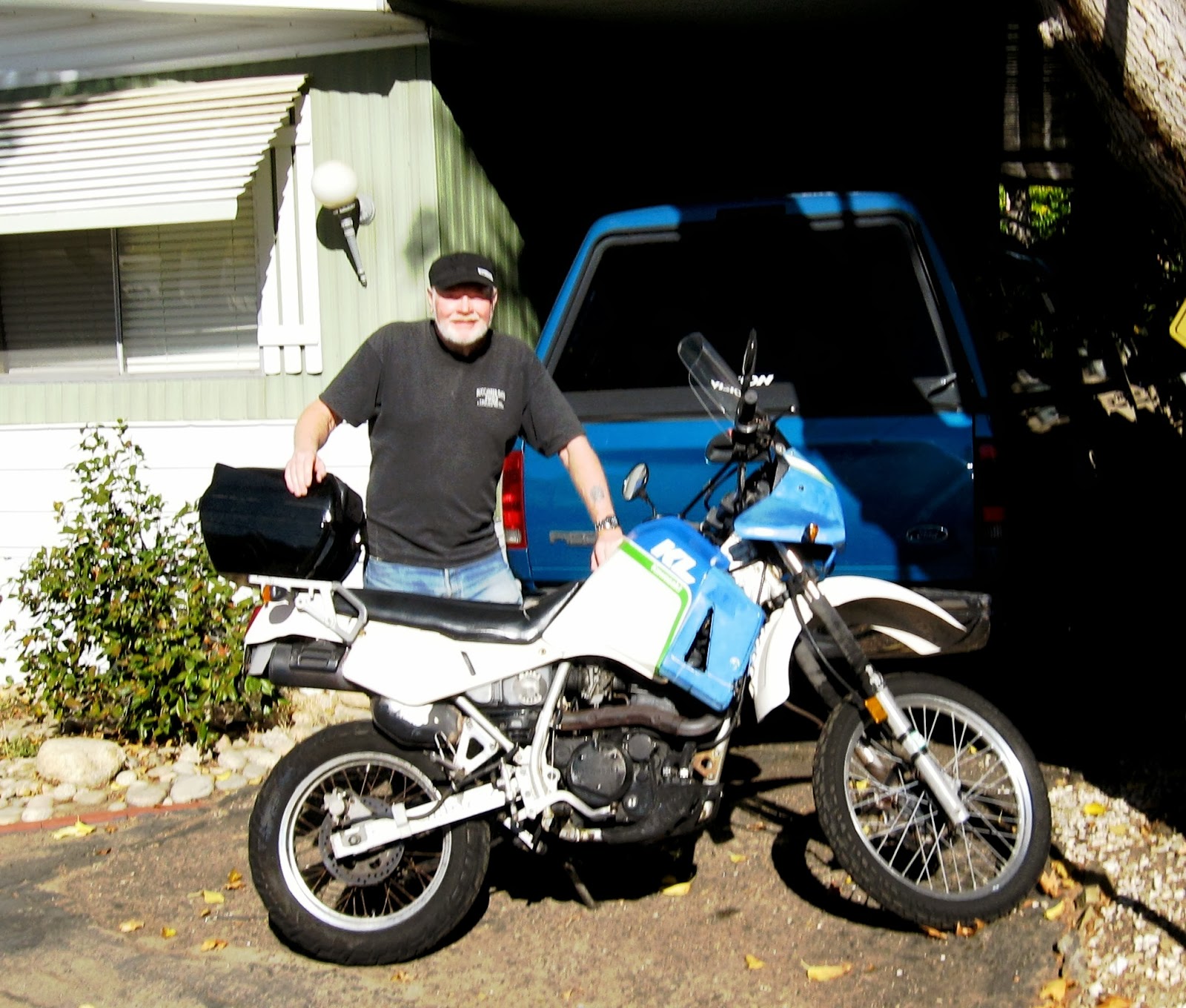
I left Seal Beach early Monday morning aboard my reliable 1988 Kawasaki KLR single cylinder 650 Dual Purpose trail/road machine that after eight years with me aboard had an odometer approaching 50,000 miles. I’d written a memoir with it on the cover: ROAR AND THUNDER, MOTORCYCLE JOURNEYS that covered the twenty-odd motorcycles and 250,000 ridden miles in my lifetime. Like the rider, the machine was old and looked beat-up.

I intended to ride a loop instead of going back and forth along the same highways. Overcast and foggy gloom welcomed me along the 605 to the 210 and when I reached the 15 curving up Cajon Pass, I found pouring rain as I ran out of gas. I had 103 miles on a tank fill a week before but there wasn’t enough money for a complete fill. Now on Reserve (supposedly about 20 more miles), I slowed and stayed wet to the Summit where I filled with almost a full gallon still in reserve.

Rain stopped at the 395 turn-off. I had heavy buffeting winds along the long straight two-lane highway. The KLR is light (325 lbs) so getting knocked around with wind had me stopping at Inyokern for tea and a walk-around before I rolled onto the 178 West toward Lake Isabella. Weather was sunny and cool for November. I had always thought the best months for travel were April and October. Weather is generally pleasant, teachers and kids are in school, and tourists are home doing whatever tourists do at home. Except for an occasional big rig, traffic didn’t exist. Cars passed going the other way but only four 80mph cars swept past going my way. I stayed at 70 out of respect for my old engine.


(Rolling on 178 West out of Inyokern toward Lake Isabella, odd cactus along the road)

Highway 178 was curvy and pleasant with odd cactus growing along it. At Lake Isabella, I took Sierra Way up to Kernville and a reunion with my brother, Don and the cool wonder dog, Zeke. Don rents a mobile home in a small park surrounded by elderly women he thinks are after his body. And maybe they are. The three I met sure were friendly. How he found the place was interesting. Since his split with his wife in Palm Springs and was now living on Social Security, he went on Google and asked for the cheapest place in the country to live. He drew three: a small hamlet in Texas, a trailer park in Spokane, and Kernville. I’m thinking of doing that for marina slips.


(Downtown Kernville, the Kernville Saloon)

Kernville is a pleasant metropolis of 1,200. But Don misses many offerings of city life: multi-screen theaters, a decent library, a Chinese restaurant, a sports bar for football. He didn’t miss the city mob and their rudeness. We did find an excellent spaghetti place and an outstanding breakfast café where we both ate too much. Mostly we talked, and talked, we hadn’t been alone one-on-one for any real time since we were kids. Either he had a wife or I had a wife or we were surrounded by family, or we were each off alone someplace. None of that existed now and we spent our time talking and walking Zeke along the Kern River and into deep forest where Zeke liked to chase squirrels. I didn’t have room on the KLR for my gold pan or shovels or buckets but next visit I intended to bring them in the Explorer. The Kern River was down which made fishing at the dam good and maybe meant gold hidden under now-dry boulders.


(The KLR and me, Don’s coach and F-150 in the background, Kernville.)


Don and I are Irish twins, in that we are three days shy of being one year apart. So for a couple days we are the same age, and that’s what we were celebrating. I slept on a fold-out bed in the living room of his rented coach. When I asked if he intended to buy the coach (it was offered), Don told me that at his age, he was through owning stuff, a philosophy I sort of share. He believes things own you, be it house, car, a closet full of clothes or mechanical toys that restrict your personal freedom. He’s done with all of it. I own my boat, the Explorer and the KLR. Too much, except my boat is my home, and where I live requires private transportation of some kind. A thousand dollar car would work fine. I live on Social Security, a small retirement from Boeing, and my paltry book royalties.

Since Kernville has no chain grocery market and the one small store charges ridiculous prices, Don has to drive his F-150 fifteen miles down to the city of Lake Isabella for serious food shopping. The road is twisty and the drive bothers him. Sometimes he thinks about moving to Bakersfield where we both grew through high school, and where I couldn’t wait to leave, and did, to serve my machinist apprenticeship in Houston before going in the Navy. He says he’ll probably stay in Kernville but he doesn’t like that drive. I was to take that road going home.

Despite our marathon conversations and walking Zeke the wonder dog, I did figure mileage for the trip up. I had ridden 286 miles and at mostly 70mph. the KLR gave me 48.8 mpg. The ride home would be shorter through Bakersfield.


(Don and the quiet, obedient wonder dog, Zeke, DNA shown to be one-third Poodle, one-third Wire Terrier, one-third Whippet, well trained (poops on command), does not bark except when parted from his greatest companion,)

Don and I parted sadly Wednesday morning, with promises to do it again. I had my backpack bungeed on the seat behind me, not as soft to lean back on as a woman but we make do. I rode out of Kernville and down the wicked road Don dislikes to Lake Isabella where I reconnected to Highway 178 West, forty-nine miles from Bakersfield. I didn’t look forward to the twisty Kern Canyon Road with its 15 to 30 mph switchbacks and a long drop to the Kern River. Two or three are lost on that road every year. But I took it easy. The machine loves those tight curves and in my youth I did too. But we were both too old to lean at speed coming down the mountain.


(Approaching Lake Isabella to connect with 178 West, Kern Canyon Road, Bakersfield, and home.)


In Bakersfield I caught the 99 freeway and rode the long straight to the I-5 connection and up the steep Grapevine, buffeted by heavy winds that rocked me and the machine so hard we were often pushed out of our lane. At the top, construction had the highway down to one lane with a long line of big rigs. Cars were going nowhere, sometimes stopped for minutes. I stayed with them for a short time then took the asphalt shoulder to ride past the whole bunch and away to free open road. The only rest stop of the trip was at the top, where I walked around and drank water from a public fountain. Somewhere along the canyon or Grapevine I had lost my water bottle.

The worst, most tiring part of the trip was riding into the Los Angeles basin, where traffic was heavy and heat oppressive. To avoid the LAX mess along the 405, I took the 210 East that still had impressive traffic, and rode to the 605 South to Long Beach then Seal Beach and my sailing home.

The homeward leg of the trip covered 205 miles and the KLR gave me 50.2 mpg. Not bad for an elderly machine and rider. I returned rejuvenated and ready to work again, back to my kick-ass gal private eye, Makayla “Mac” Tuff and her first novel, PILLOW SHOT.

Future sojourns include gold prospecting in Alaska and Australia, and a six month back-pack trip across Europe. Life is one endless bucket list.

Available Books: www.amazon.com/georgesnyder/e/b007upcafg


Sunday, October 20, 2013


CAN YOU BELIEVE THEY INTERVIEWED ME ?

Page to Page Interview

            Thank you for joining us for an author interview. We have created a range of questions from your work, to some a little more personal, so that your current and future readers can become more familiar with you.

A Little on the Personal Side: 

·        What types of books do you read?

I read what I write—hardboiled crime novels. Just finished BUTCHERS MOON by Richard Stark (the late Donald Westlake), and before that two Sunny Randall novels by Robert B Parker. I’ve read most of them from Lee Child to Lawrence Block plus the masters, Chandler, Hammett, to paperback originals from John D. and Richard Prather. I have read literary types from Hemingway, Somerset Maugham, John Steinbeck, back to Dickens, Victor Hugo, Herman Melville and my pal Bill Shakespeare. I do like diversion occasionally and my next book to read is about the first man ever to ride around the world on a motorcycle, in 1912, aboard a 1912 Henderson, written by my good friend, Dr. Gregory Frazier, who himself has ridden five times around the world and has more than a million miles on different motorcycles. I only have a few hundred thousand miles on my motorcycles.


·        What do you love most about writing? What do you not like?

I love the routine of looking forward to it. I write early mornings so when I wake, just before climbing out of the rack, I churn in my mind what I’ll be writing. It’s hard to begin a novel but once into it, I look forward to creating characters and scenes every day. When on a book, I write five to six hours a day, seven days a week. My “office” is the dinette table aboard my sloop where I live. What I do not like is easy: publicity and marketing. I dislike every part of it, it’s like peddling my books as if they were vacuum cleaners. Even though I know it’s necessary because publishers don’t do that anymore, it still makes me uncomfortable because I’m an introvert. Friends and family often accuse me of being a hermit, squirreled away in the dark cabin of my little sail boat ticking away on laptop keys.  


·        When you are not writing where can you be found?

I can be found in used bookstores (can’t afford new), although I do have a Kindle. Or sailing, maybe for a day sail if I can scare up a feminine friend or over ocean swells to Catalina Island for a weekend of fishing and snorkeling with or without feminine friends, or in my boat cockpit reading, or gold prospecting in Arizona and Nevada, or riding my dual purpose motorcycle, either on the highway or along fire trails and mountain roads in search of gold, or in a movie theater watching a film, usually alone because I like matinees. Or you might find me on a road trip, camping in the back of my Explorer.


A Little on the Professional Side: 


·        Of all of the characters you have written, which has been your favorite? Why? Least favorite? Why?

Before my novel THE FAREWELL HEIST was released I had another titled CROSSFIRE DIAMONDS. In it is an assassin, Yolanda Smart tall, thin, black, sharp who has become my favorite character because she is cold, calculating and professional besides being beautiful and looking like an African princess. A close second is the young woman from India, Asin Bhandi, in my forthcoming Logan Sand novel, THE CALCCUTTA DRAGON, because she is feminine perfection and knows it, and mentions it. Plus I love my villains. They are hissingly evil and commit detestable acts, the type of dastardly creeps readers love to hate. Me too. But of course my top favorites are my three series leads: Baylor ”Bay” Rumble (four books: BAD GIRL DEAD, BLEEDING SISTERS, CATALINA KILLERS, BAJA BULLETS), Logan Sand (two books: THE CALCUTTA DRAGON, PLUNDERED ANGELS) and Makayla Tuff (writing first book: PILLOW SHOT).


·        What is your thought on eBooks being the new way to read?

eBooks are the future but they’re not the end all be all of books. They still don’t take well to color pictures. My Kindle doesn’t have page numbers. They are not as easy to read as books. They host several other undesirable traits. But the biggest danger for eBooks is price. The one looming attraction for them is books are cheap. But I see publishers submitting to their greed by charging $6-$8-$11 and even $13 for books that aren’t special except they come from a hot-shot author through a big name publisher. That will be the demise of eBooks. I have many books stored on my Kindle, including four of my own. I’ve read three books, one after the other. I still prefer books with pages I turn.      


·        Who is your ideal reader?

Readership for me is a slog. Because my books are tough and masculine to the point of pulp, most women don’t care for them. Not much display of woman empowerment in them. Since 80% of readers are women, and the majority of books published are a form of Romance, the landscape is kind of barren for my kind of tough crime novels. My ideal readers are men, likely working the hands-on trades. Prisoners like my books. But, with only a portion of a 20% readership, and I just read that 80% of men college graduates never read another book after graduating, and 45% of families don’t read books, it looks like an uphill crawl out there for my kind of books. Why not give in and write what they’re reading? Because I don’t read that stuff, and I don’t write it. Few of us are in this for the money. I live with the reality.  


A Little Quick Fire:


*When it comes to books*


Good Guys or Bad Guys? Bad guys

Fiction or Non-Fiction? Fiction

Handwritten or PC typed? PC typed

Cozy Nook or Outdoors Oasis? Neither. Mean streets and guns.

Happily Ever After or Nail-biter? Nail biter

Writing or Reading? Writing


*When it comes to you*


Ice Cream or Cake? Neither, too much sugar

Chocolate or Vanilla? Neither, too much sugar

Coffee or Tea? Coffee

Dress Up or Dress Down? Dress down. Onboard, cut-offs and t-shirt.

Barefoot or Shoes?  Usually boat shoes.

Cook or Order Out? Survival cook.


Online Presence:


Your Twitter: geo_snyder


Fill in as much or as little of the following as you wish:

Up to 3 of your book titles and their corresponding sell links:


1 THE FAREWELL HEIST by George Snyder


2 BAJA BULLETS by George Snyder


3 CROSSFIRE DIAMONDS  by George Snyder